Satin or grosgrain? How to choose the face
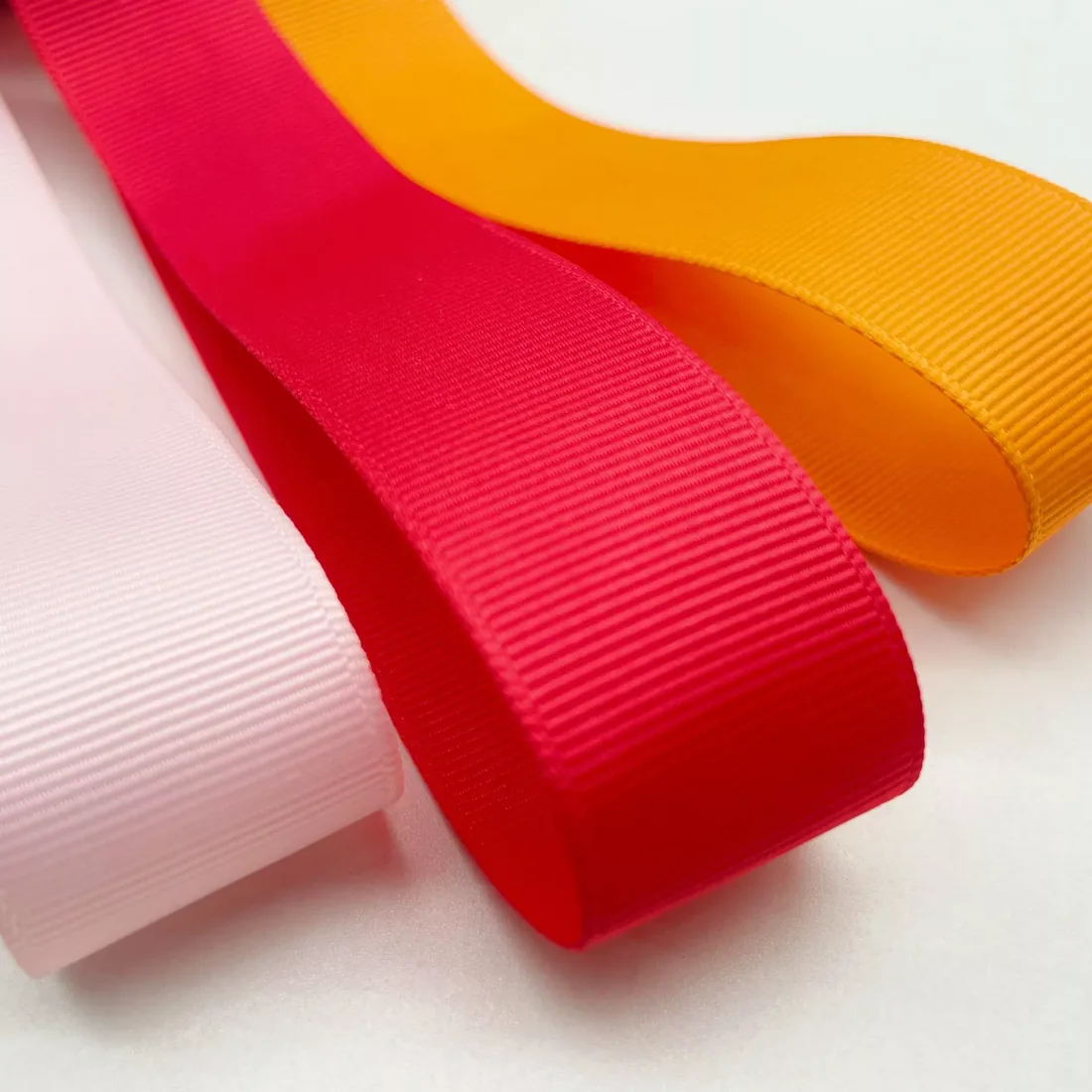
The two most common ribbon faces fail in opposite ways. Satin is smooth, so it looks better than it grips: a knot in satin will slide if the box is handled. Grosgrain is ribbed, so it grips and hides a crease, but the rib softens fine print. Almost every ribbon decision comes back to that trade.
Where satin wins
Satin catches light along the width, which is why it reads as gift packaging. It takes print on a flat face, so a logo repeat lands cleanly, and it folds flat across the edge of a lid without showing the fold line. Single face satin is lighter and cheaper and is the usual choice when the ribbon is laid flat and seen from one side.
Where grosgrain wins
Anything that has to hold: hat bands, apron ties, lanyards, bag handles, closing tape on a box that gets opened more than once. The rib stops the knot moving and the face does not go shiny where it is handled. It also survives being tied and untied repeatedly, which is what a lanyard does all day.
What this means for print
On satin, the limit is the weave: line work finer than about 0.3 mm softens, so small text is set bolder or moved to a wider ribbon. On grosgrain the rib adds a second limit, and fine detail breaks across the ribs. A strike-off at the actual width answers both questions in a minute, and it is the reason no printed programme starts without one.
How to decide in one question
Ask what the ribbon is doing after it is tied. If it is decoration on a pack that is opened once, satin. If it is a component that will be adjusted, tied and untied, or pulled, grosgrain. If both, the pack usually takes satin and the trim takes grosgrain, from the same dye lot so the shades do not drift apart.
Questions this guide raises
- Can the two be used in the same pack?
- Yes, and it is common: satin on the box, grosgrain on the bag handle. Order them together so both come off the same dip.
- Which one is more expensive?
- At the same width and quality they are close. Grosgrain uses slightly more yarn, satin needs more care in finishing, and the difference is usually smaller than the shipping.
- Does either fray more?
- Both are woven, so both can fray at a cut end. A hot cut seals the edge and is the default for cut lengths; a sheared straight cut is for rolls that will be cut in-house.
Ask about your own programme
Send the reference you want matched, the width in millimetres and the quantity per colour. You get a price, a lead time and a sample date back, usually within one working day.